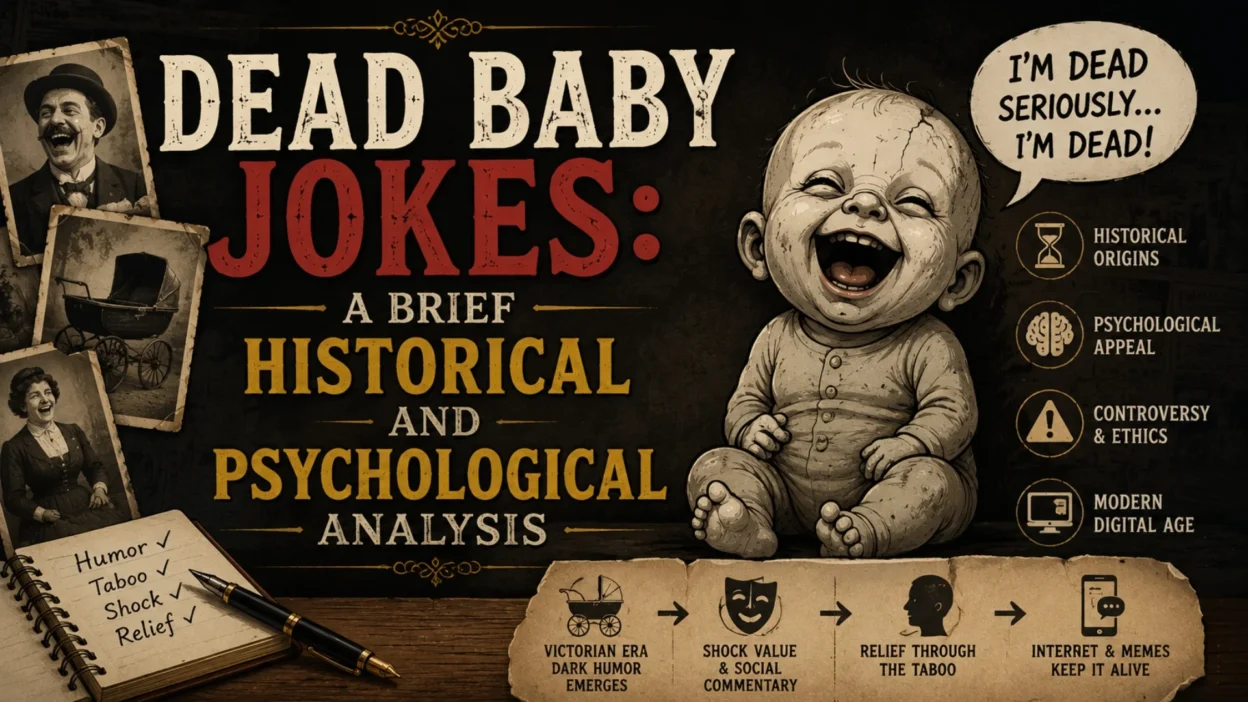
The online world is filled with various forms of humor, and few are as controversial or misunderstood as dead baby jokes. This article explores this specific genre of dark comedy, a joke cycle that has persisted for decades, to uncover its origins, the psychological reasons behind its appeal, and the significant social and ethical lines it crosses.
🔍 Origins of the Dead Baby Joke Cycle
The dead baby joke cycle didn’t emerge randomly. It has a specific historical and sociological origin that scholars have traced back to the early 1960s in the United States.
- Folklorist Alan Dundes first identified and studied this joke cycle in his 1979 paper, “The Dead Baby Joke Cycle”.
- Dundes linked the rise of these jokes to second-wave feminism and changing societal roles for women.
- Some researchers also connect the cycle’s emergence to graphic images of infant-related violence from the Vietnam War.
- The jokes are designed as riddle-based cycles, beginning with a “what” question answered by a grotesque punchline.
- This structure allows for easy memorization and variation within the “dead baby” theme among social groups.
- Early variations of sick humor may have been inspired by English poet Harry Graham’s 1899 “Ruthless Rhymes for Heartless Homes”.
- Unlike general dark humor, this cycle specifically targets infants, one of society’s most protected symbols.
- The genre exploded in pre-internet youth culture, passed along orally in schools and at camps.
- Dundes saw the cycle as an outlet for American adolescents to discuss taboo topics like disease and death.
- The “sick humor cycle” classification includes dead baby jokes alongside other offensive categories like Holocaust jokes.
- This genre’s rise coincided with broader cultural shifts and the sexual revolution of the 1960s.
- The anonymity of the “dead baby” in the jokes removes individual identity, focusing purely on shock.
- By the 1970s, these jokes had become a recognized staple of underground comedy circles.
- The cycle’s persistence suggests it serves a recurring psychological function for each new generation.
- Understanding this origin helps differentiate the cycle from one-off morbid jokes found online.
- The “dead baby” theme became a template, allowing infinite variations on the same shocking premise.
🧠 Psychological Theories Behind Appreciating Dead Baby Jokes
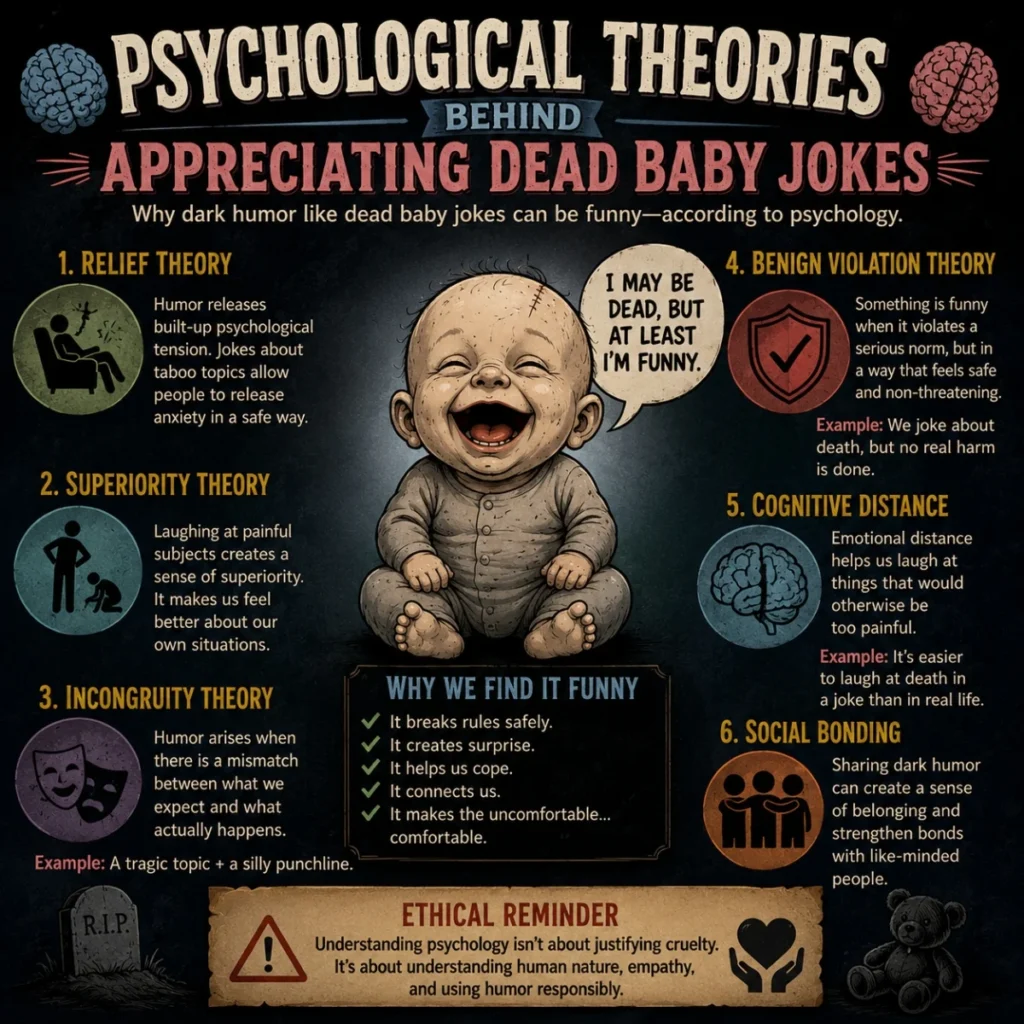
The enduring popularity of dead baby jokes can be explained by several established psychological frameworks that reveal how our minds process discomfort and anxiety.
- The Benign Violation Theory suggests humor arises when a violation feels simultaneously wrong and okay.
- Dead baby jokes create psychological distance, making a horrific event feel hypothetical and therefore funny.
- These jokes serve as a coping mechanism, allowing people to confront immense fears in a controlled environment.
- Exposure to taboo humor can build emotional resilience, acting like a vaccine against future adversity.
- Psychologist Bob Mankoff compares offensive jokes to immune system challenges that strengthen mental fortitude.
- Alan Dundes argued the jokes relieve deep-seated anxiety about parenthood among adolescents.
- The format represents a release of repressed societal impulses that polite conversation forbids.
- Laughing at the unthinkable provides a brief, intense form of psychological relief from stress.
- Studies on sick humor show those with high appreciation often have high cognitive complexity and openness.
- Time functions as a key variable in distance; jokes about old tragedies are generally considered less offensive.
- The reaction “Too soon!” highlights how time diminishes violation, making gallows humor acceptable.
- The abstract “dead baby” becomes an object, allowing the brain to process the joke without empathy triggers.
- For some, telling the joke is less about laughter and more about demonstrating fearlessness regarding taboos.
- The genre allows adolescents to explore adult anxieties about death and responsibility in a peer setting.
- Cognitive theories propose that resolving the incongruity of a grotesque answer generates a laughter reward.
- The jokes function as a “trial run” for true adversity, preparing the psyche for potential future loss.
⚖️ The Controversial Nature of Dead Baby Humor
No discussion of dead baby jokes is complete without examining why they remain one of the most controversial and offensive forms of humor in modern society.
- Dead baby jokes rank among the most extreme examples of off-color humor, violating nearly every social convention.
- They are a primary example of a taboo violation, finding humor in the death of the most vulnerable.
- Folklorists classify them within the broader category of sick humor cycles, alongside other extreme content.
- The jokes derive power from crossing social boundaries that most people are afraid to approach.
- Psychologist Peter McGraw notes that too much violation without perceived “benign” framing kills the humor entirely.
- In stand-up, comedians like Ricky Gervais have sparked major outrage for performing dead baby material in public.
- Gervais faced backlash from a bereaved couple in Belfast who walked out of his show after a dead baby segment.
- The comedian defended the joke as part of free speech, distinguishing between the subject of a joke and its target.
- Support networks like Sands NI issued warnings to grieving parents about the potentially upsetting nature of such jokes.
- The reaction to the jokes is often polarized: laughter from some, intense grief and anger from others.
- The debate over these jokes highlights the conflict between artistic expression and the protection of trauma survivors.
- Many find the jokes “not funny” specifically because they target a type of loss that is uniquely devastating.
- The controversy extends to online spaces, with Reddit communities like r/deadbabyjokes facing constant moderation challenges.
- Research indicates that deeming a joke “offensive” is highly subjective, tied to personal moral attitudes and life experience.
- The presence of a “dead baby” punchline often short-circuits normal empathy, forcing a jarring emotional response.
- The controversy ensures the cycle remains underground, perpetuating its mystique and shock value for new audiences.
📝 Classic Examples and Recurring Themes in the Genre
The dead baby joke cycle relies on a few recurring formulas and themes that have been repeated and remixed for decades in both oral and written traditions.
- The “Difference” Formula: “What’s the difference between a dead baby and X?” is a classic structural template.
- Example: “What’s the difference between a truckload of dead babies and bowling balls? You can’t unload bowling balls with a pitchfork.”
- The “Worse Than” Formula: Jokes often escalate through comparative disgust, e.g., “What’s worse than X dead babies?”.
- Example: “What’s worse than five dead babies in one garbage can? One dead baby in five garbage cans.”
- The Kitchen Appliance Trope: Blenders feature heavily as a method of infant reduction (“How do you get 100 babies into a box?”).
- Microwave Variant: “What’s brown, bubbling, and knocking on a window? A black baby in the microwave.”
- The “Float” Pun: “How do you make a dead baby float? Take your foot off its head.”
- The “Arms and Legs” Trope: Names for a baby with no limbs: “Bob” (pool), “Sandy” (beach), “Matt” (porch), “Art” (wall).
- The “Nailed to a…” Image: “What’s sadder than a dead baby nailed to a tree? A dead baby nailed to a puppy.”
- The Clown Costume: “What’s funnier than a dead baby? A dead baby in a clown costume.”
- The Onion Comparison: “What’s the difference between a baby and an onion? No one cries when you chop up the baby.”
- The Garbage Disposal: “What’s red and goes round and round? A baby in a garbage disposal.”
- Wordplay Variants: “What do you call a dead baby? Spawn killed,” playing on video game terminology.
- Repetition: Many jokes follow a “How do you get them out?” follow-up, usually involving Doritos.
- Taboo Objects: The inclusion of sexual acts with the infant corpse pushes the boundary into sexual taboo realms.
- The “Pitchfork” Motif: A tool used to distinguish between infants and inanimate objects, implying disposability.
- The Live Baby in the Pile: An escalation that introduces a cruel survival element into the carnage.
🌐 Dead Baby Jokes in the Digital Age
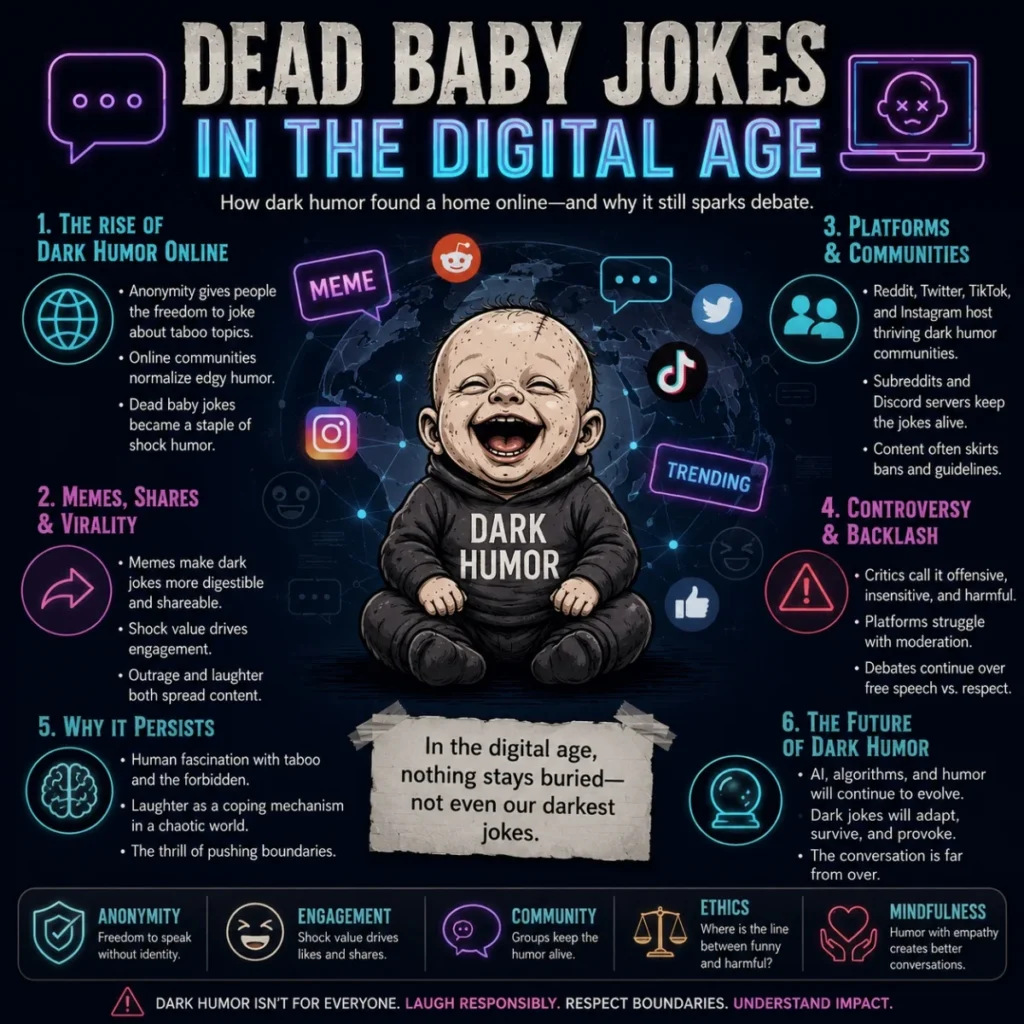
The internet and social media have dramatically altered the spread and nature of dead baby jokes, transforming them from an oral tradition into a global, often anonymous, digital phenomenon.
- Online communities like Facebook Groups dedicated to “dead baby jokes” attracted thousands of members in the platform’s early years.
- The creation of r/deadbabyjokes on Reddit provided a centralized hub for sharing and archiving the genre.
- Polygon reports that these digital spaces thrived on the desire to shock within the constraints of a character limit.
- The internet removed the social risk of telling these jokes in person, encouraging more extreme variations to emerge.
- Search engines today return thousands of results for the keyword “dead baby jokes,” indicating persistent demand.
- The “dead baby” meme format allows rapid mutation, combining images with classic joke formulas to maximize impact.
- Anonymity online lowers inhibition, leading users to post content they would never say aloud in mixed company.
- The cycle saw a resurgence in the early 2010s through platforms like Twitter and Tumblr, often within counter-culture groups.
- Moderation challenges force platforms to constantly balance free expression against graphic or harmful content guidelines.
- The jokes have become a staple of “edgy” humor tests, with users daring each other to find the most offensive punchlines.
- Algorithmic content distribution on TikTok and YouTube Shorts can inadvertently surface these jokes to unprepared audiences.
- Digital archives at institutions like USC Folklore now preserve online versions of the jokes for academic study.
- The speed of the internet allows new joke variations to go viral globally within hours rather than months or years.
- Online forums often feature “dead baby joke threads” where users compete to outdo each other in grotesque creativity.
- The persistence of these jokes online confirms that dark humor remains a significant part of digital subculture.
- Unlike past generations, today’s youth encounter the full cycle instantly, without the buffer of oral transmission.
🛡️ Ethical Boundaries and Social Impact
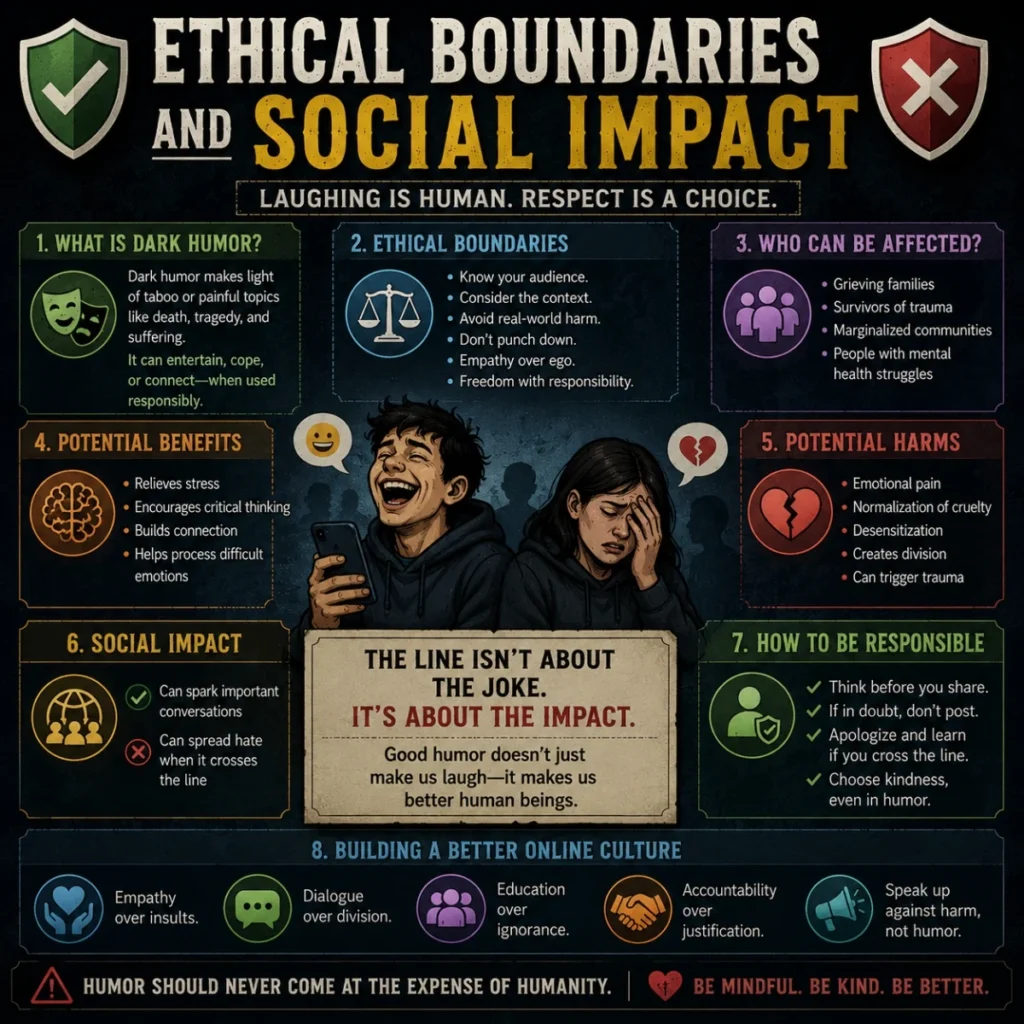
The ethical implications of dead baby jokes extend far beyond mere offense, raising profound questions about the responsibility of both joke-tellers and the platforms that host such content.
- The jokes directly intersect with real-world trauma, as seen when bereaved parents encounter them unexpectedly in public performances.
- Stillbirth charities have issued public warnings to parents, highlighting the real emotional danger these jokes pose to vulnerable individuals.
- One child loss advocate wrote that finding “almost a hundred dead baby jokes” online was “appalling” and deeply hurtful.
- Psychologists caution that using dark humor as a constant mask can hide serious underlying depression or trauma.
- The benign violation theory breaks down when the listener has personal experience with infant loss; the violation is no longer benign.
- Advocates argue that such jokes normalize violence against the vulnerable, potentially desensitizing society to real-world atrocities.
- The debate over Ricky Gervais’s material encapsulates the clash: comedy as free expression versus respect for individual grief.
- In some religious interpretations, such jokes are considered haraam for their gratuitous cruelty and insensitivity to human suffering.
- The psychological concept of moral luck plays a role; those untouched by infant loss are statistically more likely to find the jokes funny.
- Platforms like Facebook and Reddit struggle to moderate this content, as it often exists in a gray area between offense and actionable harm.
- The jokes risk reinforcing harmful stereotypes if they target specific racial or demographic groups within the punchline structure.
- Stephen King’s essay “Why We Crave Horror” references this exact genre to explain humanity’s complex relationship with fear and darkness.
- The “Crosses the Line Twice” concept suggests that a joke can become funny again if it is so offensive it becomes absurd.
- However, for many survivors of child loss, no amount of absurdity can make a dead baby punchline acceptable.
- The ultimate ethical boundary is consent: an audience that chooses a comedy show assumes risk, but online content ambushes the unprepared.
- Understanding this social impact is crucial before anyone repeats or shares material from this controversial genre.
❓ Frequently Asked Questions About Dead Baby Jokes
Q: When did dead baby jokes first become popular?
A: The dead baby joke cycle is believed to have originated in the early 1960s in the United States, as identified by folklorist Alan Dundes.
Q: Why do people find dead baby jokes funny?
A: Psychological theories like the “benign violation” theory suggest that when a listener feels psychological distance from a horrific violation, the brain can process it as humor rather than threat.
Q: Are dead baby jokes a sign of psychopathy?
A: No. Experts like Bob Mankoff note that enjoying dark humor does not indicate psychopathy. It often correlates with higher intelligence and emotional resilience as a form of coping with negative emotions.
Q: What is the “dead baby float” joke?
A: It is a classic riddle in the cycle with two common answers: “Take your foot off its head” or “A glass of root beer and two scoops of baby.”
Q: Why are these jokes so controversial?
A: They violate a fundamental societal taboo by joking about the death of infants, society’s most protected symbol of vulnerability and innocence.
Q: Did Ricky Gervais really tell a dead baby joke?
A: Yes, in 2017, Ricky Gervais performed a segment on his “Humanity” tour that included extended jokes about a dead baby, which led to a bereaved couple walking out of his Belfast show.
Q: Are there still online communities for dead baby jokes?
A: While many groups have been shut down, dedicated subreddits and niche internet forums continue to exist, though they face constant moderation challenges.
🧾 Conclusion
Dead baby jokes remain one of the most enduring and disturbing examples of the dead baby jokes genre, a cycle that has persisted from 1960s America to modern Reddit threads. By understanding their folkloric origins, the psychology of benign violations, and the real pain they can inflict on grieving parents, we see that this humor is far more complex than simple shock. Whether viewed as a tool for building resilience or a weapon of insensitivity, this taboo genre forces us to confront the very boundaries of what a society finds acceptable to laugh at.

Nathan Cole is a humor writer at PunsStation who loves creating funny puns, clever pickup lines, and jokes that make people laugh